What to Consider When Buying a
Prestressing Jack
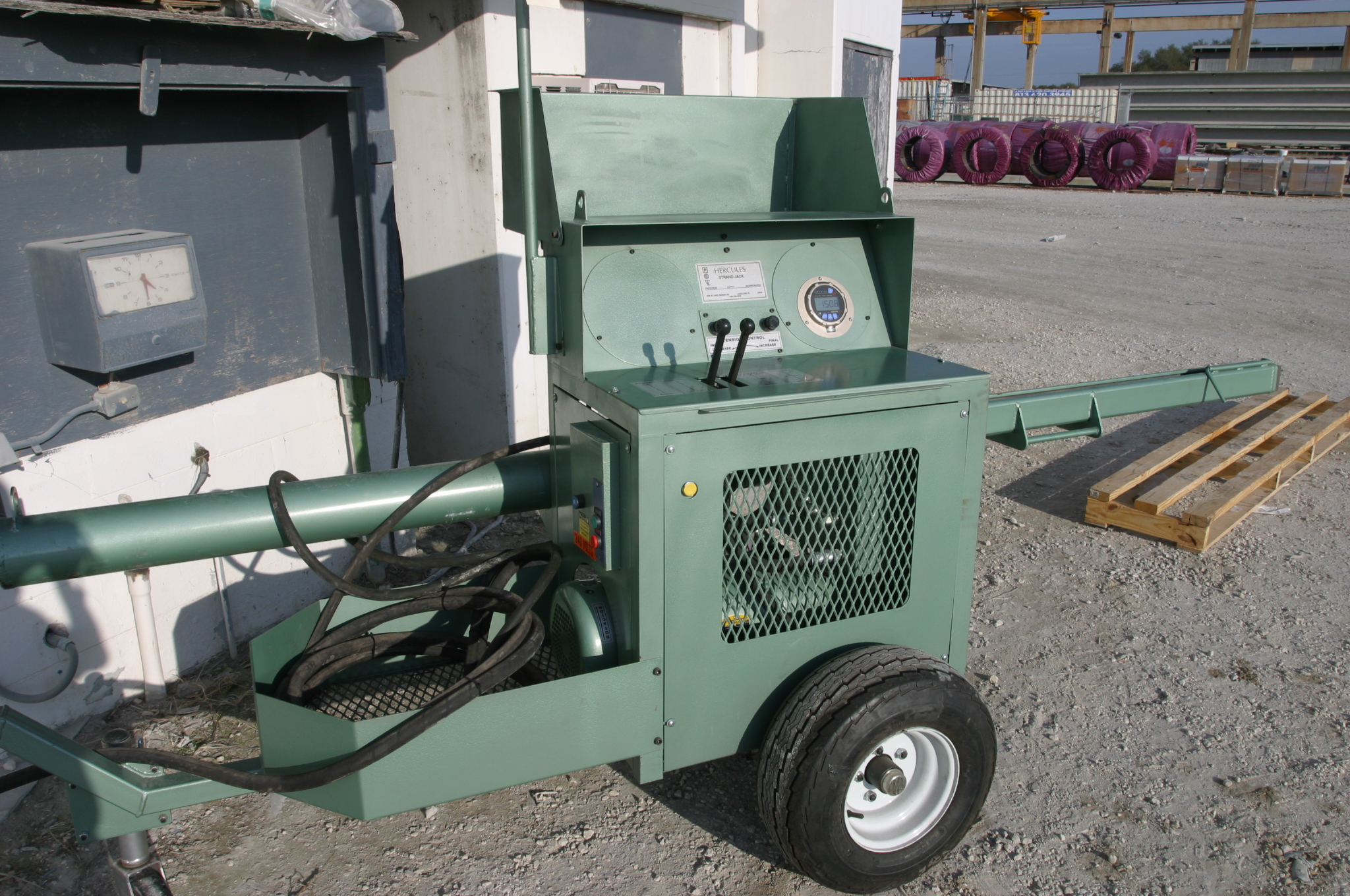 If you’re in the market for a hydraulic tensioning unit for your prestressed concrete construction, there are several factors to consider. Prestressing concrete is an excellent way to add compressive strength to concrete pilings, beams, wall and floor panels, utility poles, and many other products and applications.
Understanding Prestressing
Prestressing involves using special steel cables called prestress strands. These strands are laid in a concrete form or mold and then tensioned using a hydraulic ram and pump known as a prestressing jack. Once a predetermined load is applied, a strand chuck grabs the cable and holds it under tension while concrete is poured into the form. After the concrete cures, the strand chucks are removed, transferring the tension into the concrete.
Key Considerations
- Cable Diameter: Determine the diameter of the cable (strand) you will be pulling. Common sizes include 5/16”, 3/8”, 7/16”, ½”, and .600. Ensure your new jack can handle the required size. It’s wise to choose a unit capable of higher loads than necessary and consider future needs for larger cables.
- Ram Size: The ram is a cylinder-shaped device that attaches to the strand and applies tension. Your engineer will need to know the force to be applied and the total length of the prestress form. The unit of measurement for the amount of stretch in a cable is called elongation. You want to choose a ram with enough elongation to pull the cable in one pull. If the ram is too short, you will have to pull multiple times to reach your elongation needs, wearing out your ram. If there is a possibility of installing a longer form in the future, you should consider that when choosing your ram length.
- Regulations and Certifications: If your company is part of an organization with specific stressing system requirements or regulations, ensure your equipment complies. Some states’ Departments of Transportation (D.O.T.) also have specific requirements.
- Gauges: You may choose between digital or analog gauges. In the US, load is commonly measured in pounds of force or PSI. Consider weather resistance, readability in direct sunlight, accuracy, ease of calibration, and ruggedness when making your choice.
- Pressure Release: Ensure the stressing unit can gently release pressure once the final load is applied. Dumping pressure all at once, known as shock loading, can cause strand failure, strand chuck damage, or gauge damage. Your jack should have a function to slowly release pressure.
- Voltage: Check the voltage available at your facility. Most prestress jacks operate on either 240-volt or 480-volt 3-phase electric, though some smaller units may work on 110-volt single-phase.
- Mobility: Consider if the stressing jack will be used in different locations within the plant. Some units come with various wheel arrangements, while others can be mounted on a skid and moved with a forklift.
- Calibration: All prestressing jacks must be calibrated upon arrival. Consult your calibrator about systems they have experience with. Your jack should be recalibrated if you change rams, replace gauges, pumps, valves, manifolds, or if elongation calculations don’t match the gauge readout. Annual recalibration is also recommended.
Maintenance
Once you’ve decided on a stressing jack, read the entire owner’s manual and follow the recommended maintenance. There is no such thing as a maintenance-free piece of equipment in a prestress plant.
PSI is a family owned and operated company that strives to provide exceptional service to our customers.